
What Are We Really Teaching Our Teens?
As parents, we spend a lot of time thinking about what we want our teenagers to learn.
We want them to work hard and be responsible.
We want them to be kind and be successful.
We want them to make good choices.
We talk to them about grades, friendships, college, careers, relationships, and the decisions that will shape their future. But there is another kind of teaching happening all the time. They are watching us. And sometimes, what they learn from watching us is more powerful than anything we say.
Your teenager is learning from the way you live.
Your teenager is watching what happens when you are disappointed. Do you allow yourself to feel it? Do you become critical of yourself? Do you pretend you’re fine when you’re not? They’re watching what happens when you’re angry. Do you yell? Shut down? Take a pause? Come back and talk about what happened?
They’re watching how you handle being wrong. Do you defend yourself at all costs, or can you say, “I was wrong. I’m sorry.”? They’re watching how you treat yourself. Do you constantly criticize your body, your appearance, your abilities, or your choices?
They’re watching whether you ask for help. And they’re watching what happens when someone sets a boundary with you, or when you need to set one with someone else.
None of this means you have to become a perfect example for your child. Actually, I think trying to be a perfect example can create its own kind of pressure. Your teenager doesn’t need to see a parent who never struggles. They need to see what it looks like to struggle and respond intentionally.
We teach values through our reactions. We might tell our teenagers that failure is a part of life. But what happens when we fail? We might tell them that their worth isn’t determined by their accomplishments. But what do they hear us say about ourselves when we don’t meet our own expectations?
We might tell them it’s important to communicate. We might tell them to take care of themselves. But do they see us having difficult conversations or see us taking care of ourselves or constantly putting everyone else’s needs ahead of our own?
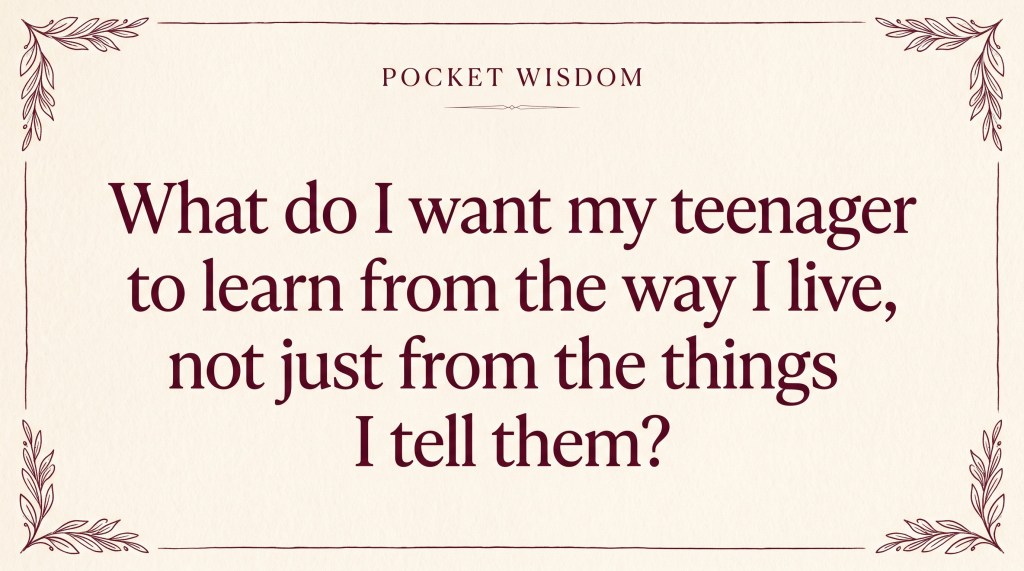
This isn’t about guilt. It’s about awareness. Because sometimes the most important parenting question isn’t, “What do I need to tell my teenager?” It’s, “What am I showing them?”
What happens when life doesn’t go according to plan?
Imagine your teenager failing a test.
It’s easy to jump in with:
“You should have studied.”
Or
“You need to take this more seriously.”
And sometimes those conversations are necessary.
But there is another question we can ask ourselves:
What do I want my teenager to learn from this moment?
Maybe the lesson is that failure gives us information.
Maybe it’s that we can be disappointed without deciding we’re a failure.
Maybe it’s that we can look at what went wrong, make a different plan, and try again.
The same thing applies to relationships.
Your teenager has a conflict with a friend.
We might immediately want to tell them what to do.
“Ignore them.”
“Just apologize.”
“They’re not a real friend.”
But what if we also help them learn to ask:
What happened?
How do I feel about it?
What do I need?
What boundary might I need?
Those are skills they’ll need long after they leave our homes.
Your teenager is learning how to be an adult by watching adults. This is one of the reasons parenting teenagers can feel so complicated. We’re not just teaching them how to get through high school. We’re helping them develop a relationship with themselves. We’re helping them learn how to handle disappointment, conflict, responsibility, uncertainty, relationships, and change.
And we’re doing that while they’re watching us navigate those same things. So perhaps the goal isn’t to show them how to have everything figured out. Perhaps the goal is to show them how to figure things out.
Show them that you can change your mind, that you can apologize and ask for help.
Show them that you can have a strong emotion without allowing that emotion to make every decision for you. Show them that boundaries aren’t rejection and rest isn’t laziness.
Show them that making a mistake doesn’t make you a bad person, that being an adult doesn’t mean having all the answers.
You don’t have to parent perfectly.
If you’ve read this and thought, “Oh no. My teenager has seen me do all of those things,” take a breath.
Some of the most powerful lessons can happen after the difficult moment.
You lose your temper? Go back and repair.
You make a mistake? Own it.
You realize you handled something poorly? Talk about it.
You need help? Ask for it.
These are lessons too. It teaches your teenager that relationships can survive mistakes.
That accountability is possible and perfection isn’t a requirement to be worthy of love. Remember growing doesn’t stop when we become adults.
So what are you teaching without saying a word?
This week, instead of asking yourself whether you’ve given your teenager enough advice, try asking yourself:
What are they learning from watching me?
What are they learning about emotions?
What are they learning about relationships?
What are they learning about failure?
What are they learning about boundaries?
What are they learning about asking for help?
What are they learning about themselves by watching the way I treat myself?
The goal isn’t perfect answers, just noticing. Because one of the greatest gifts we can give our children isn’t simply telling them who we want them to become and watching them grow. It’s letting them watch us grow and become, too.
Thank you for taking the time to read my post. I’m just trying to offer a few words of wisdom in a complex world. If this resonated with you, I’d love for you to subscribe, leave a comment, or share it with someone who may need it too. Life can be hard—and you don’t have to navigate it alone. I’m here to help.
To learn more about the services I offer, visit:
Instagram- peaceandgracetherapeutic
TikTok-@peaceandgracetherapeutic
Peace & Grace Therapeutic Services LLC Facebook
LinkedIn- linkedin.com/in/jenniferbailey


Leave a Reply