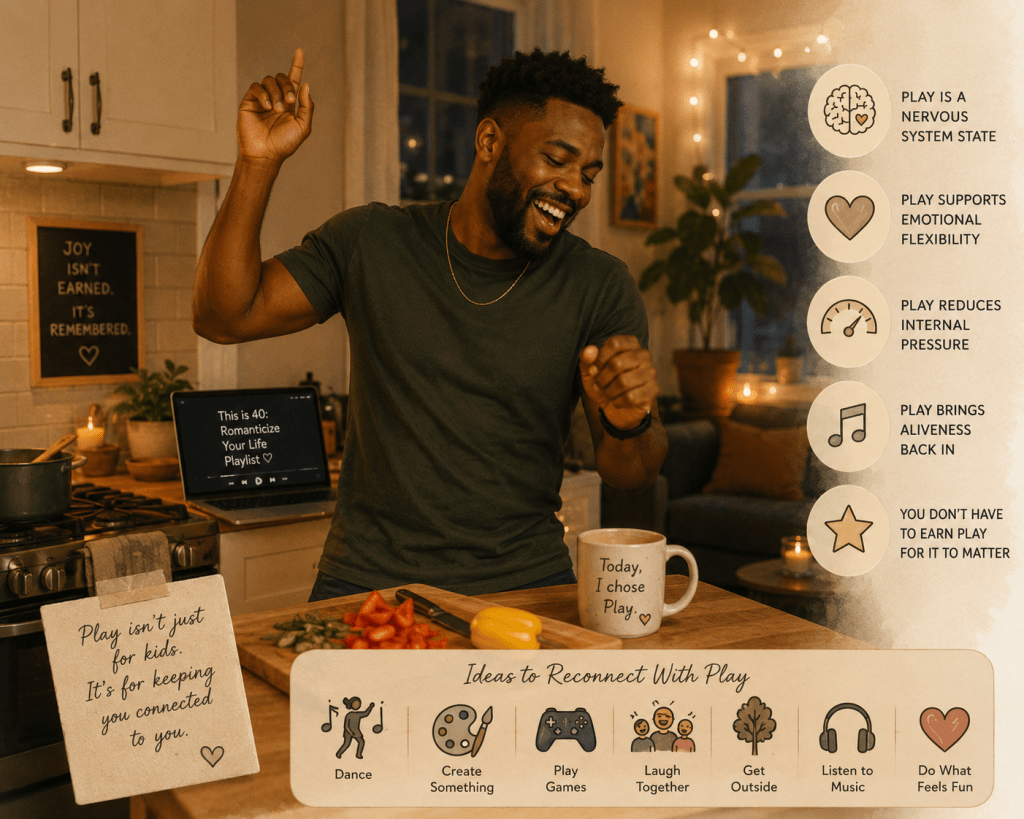
I was making dinner one afternoon, my husband was picking up our children, so I had the house to myself. A thought entered my brain that I should get my laptop and knock out some work things while I was making dinner.
But then…
Another thought entered my mind. “Play music instead”. So I did. I went to my “This is 40: Romanticize your life playlist” and put it on shuffle. I danced. I sang. I put on the best concert of my life. And thats when I noticed this subtle wave of joy. A moment solely for me, a moment where I got to play.
At some point in adulthood, play often becomes less central to daily life. Not because we consciously choose to lose it but because responsibilities increase, routines become more rigid, and productivity slowly takes priority over spontaneity. Over time, what once felt natural can begin to feel optional, or even unnecessary.
But play is not just recreational. It is a developmental and emotional need.
What Play Actually Is (Clinically Speaking)
Play is often misunderstood as something that belongs exclusively to childhood. But from a nervous system perspective, play is a state of flexibility. It is what happens when there is no pressure to perform, produce, or perfect. In this state, the nervous system is able to shift out of rigidity and into openness.
This allows for emotional release, creativity, adaptability, and regulation. When play is present, the system is not in survival mode; it is in connection and exploration.
How Play Gets Lost
Many adults don’t lose play suddenly. Instead, it becomes gradually deprioritized.
This often happens when life becomes heavily responsibility-driven, productivity becomes tied to identity or worth, rest is only allowed after exhaustion or spontaneity is replaced with structure and urgency.
In these conditions, play can start to feel like something that takes time away from “what matters.” But what gets missed is that play is part of what matters. Without it, emotional and nervous systems can become more rigid, less flexible, and more easily overwhelmed.
What Play Looks Like For Adults
If you are struggling to figure out what it looks like to play as an adult here are some ideas:
- Dancing in the kitchen while making dinner
- Creating something without needing it to be “good” (painting, doodling, crafting, baking, writing)
- Playing board games, card games, trivia, or video games purely for enjoyment
- Laughing with friends in ways that feel unstructured and unfiltered
- Exploring a new hobby simply because it feels interesting or fun
- Spending time outdoors with curiosity: walking, hiking, cloud watching, gardening, or swinging at a park
- Singing loudly in the car, making playlists, or reconnecting with music that feels nostalgic
- Engaging in imaginative or expressive activities like improv, drama, cosplay, storytelling, or roleplay
Why Play Is Regulating
Play is not just enjoyable, it is regulating. It creates a physiological shift in the body by:
- reducing internal pressure
- increasing curiosity and flexibility
- and offering experiences without outcome-based thinking
This is especially important in adulthood, where so much of life is structured around goals, performance, and responsibility.
Play interrupts that pattern. Not by escaping life but by reintroducing aliveness into it.
Wisdom in Practice
Choose one small activity this week that has no outcome attached to it.
No goal. No productivity. No reason beyond curiosity or enjoyment.
Let it be imperfect, unstructured, and unnecessary. The intention is not to perform a play but to allow space for it.
Wisdom to Carry With You
- Play is a nervous system state, not just an activity
- Losing access to play often reflects stress and responsibility—not personality
- Play supports emotional flexibility and regulation
- You do not have to “earn” play for it to matter
Thank you for taking the time to read my post. I’m just trying to offer a few words of wisdom in a complex world. If this resonated with you, I’d love for you to subscribe, leave a comment, or share it with someone who may need it too. Life can be hard — and you don’t have to navigate it alone. I’m here to help.
To learn more about the services I offer, visit:
Peace and Grace Therapeutic Services
Follow me on Social Media
Instagram- peaceandgracetherapeutic
TikTok-@peaceandgracetherapeutic
Peace & Grace Therapeutic Services LLC Facebook
LinkedIn- linkedin.com/in/jenniferbailey
 Peace & Grace Therapeutic Services, LLC
Leave a comment