

I’m going to take a risk and get a little vulnerable. I love structure. And because I love structure I also love my planner. I don’t mean my google calendar I mean my paper planner. Even in my youth, my planner was how I kept my life organized knowing when assignments were due, what weekends I had free. This hasn’t changed after getting married to my husband and having three beautiful and active children. I still have my paper planner it holds my work schedule, my children’s schedule and my schedule for my social life. Our family also has a monthly calendar that is hung up in our kitchen with the schedules, ranging from birthday parties they are invited to doctors’ appointments to sporting events. It’s one of the ways my husband and I sync out personal calendars as well. I know and understand that doing a google calendar may be way easier but if I’m being honest a paper calendar hits different for me, it helps me hold in mind my schedule and other family events far greater than a digital calendar. I was not aware being able to coordinate schedules was going to be a parenting skill.
In the billons of books on parenting there’s advice on having your kids engage in various activities. Sharing of how it’s a way to help our children to build relationships, social cognitive skills (that’s therapist speak for social skills) and to build self-esteem. Unfortunately in those billions of parenting books there isn’t much on how to manage the schedules of our children when they engage in all of these activities. Being able to manage your family’s schedule, plan a vacation, organize your kitchen and be able to know how to accomplish all of these things fall under the category of our next parenting skill that no one talks about, executive functioning. Let’s dive in.
Executive function (EF) is a broad label consisting of many skills that play a role in a person’s ability to manage their emotional state and behaviors, their ability to complete tasks, solve problems and manage new or unexpected situations. Think of it as the CEO of the brain. There are many skills that fall under the category of executive functioning skills a few examples include:
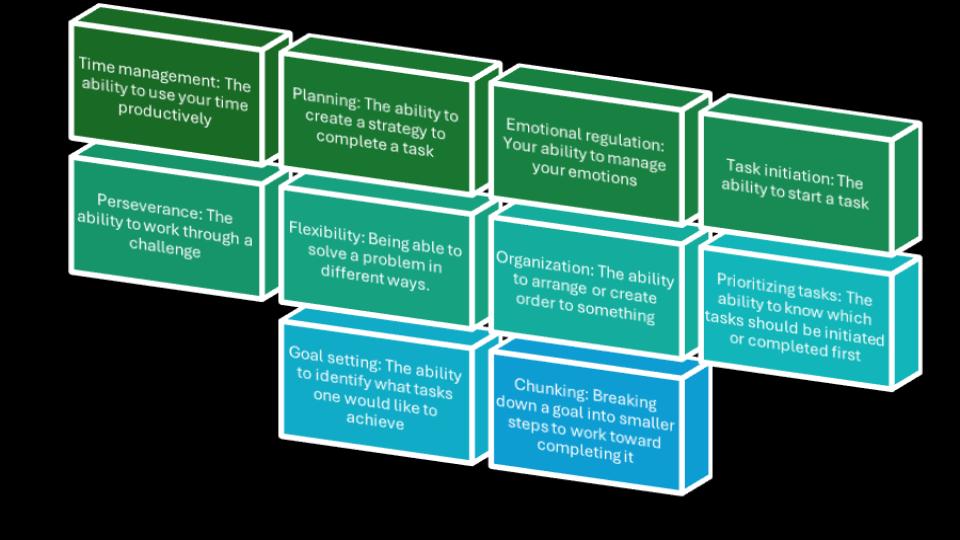
I know what you’re thinking. This is a lot, and you are right. Executive functioning is a vast and large category and its all used when parenting. To add a little more complexity to it is that you may be good at some of these things and not so much at others. The bright side is there are a lot of strategies, techniques and technology to help you if you are realizing that some of these skills are not your strengths. However before we get into that, let’s chat about why executive functioning is important when parenting.
If you have read my previous blog post you know that I did a post on emotional regulation. And if you didn’t know that you can read it by clicking on this link You Better Regulate. Since I did a post in that I won’t be covering emotional regulation in this post (even though it falls under executive functioning). I will say this in order for use to access our thinking brain (our ability to utilize our executive functioning skills) it starts with being emotionally regulated.
When we are able to access our EF skills it allows us to be able to solve problems on the fly. Think about how we need to keep track of appointments, kids games and our children’s doctor’s appointments. The challenging part is that some executive skills can be hard to put into practice. For example if you are a parent who also have ADHD the organizational component or task initiation component may be a challenge for you. If you are an anxious parent the skill of being flexible might be a challenge as the anxious brain likes to be in control and doesn’t handle the unexpected too well. If we are noticing these areas as weaknesses, it’s important for us to have strategies to help in these areas. I very much like a schedule and routine. I like to know what to expect. However, when something unexpected happens whether it be a snow day or one of my kids is sick, I have to adjust. Even if we may not be good at a specific skill in the realm of EF it’s something that we need to utilize.
Given that EF is such a board topic its best to identify which areas of EF that may be hard for you. For example if organizing is a challenge, then perhaps using labels to mark where items belong. If planning or completing tasks is a challenge using check lists, planners or graphic organizers can help with this. Maybe starting a task is the hard part, maybe its laundry or tackling that pile of dirty dishes. It could be helpful to link a preferred activity with a non-preferred. This could look like while doing dishes or laundry listening to music or your favorite podcast. Once you identify what your are good at and what you struggle with finding a book, podcast or blog can help you find ways to build skills in the areas that are hard for us. You are also welcome to reach out to me if you want some suggestions to build skills in any of these EF areas. It’s important that we are aware of our strengths as well as our deficits. Because you could be really good at planning and your partner/spouse could be good at planning. Its ok to tag team things. We are human and aren’t going to be great at all the things. If we are able to build upon are skills and strengthen our weaknesses we can also help our children in learning how to build their own EF skills so that they have a strong EF skill set when they reach adulthood.
I appreciate you taking the time to read this post, as I’m just trying to offer a few words of wisdom in a complex world. I hope you found it helpful or maybe you are already doing all of what I suggested, and it just feels good to feel affirmed. Here are the takeaways:
- Executive function a category of skills that play a role in a person’s ability to manage their emotional state and behaviors, their ability to complete tasks, solve problems and manage new or unexpected situations. (Including Time management, Planning, Emotional regulation, Task initiation, Perseverance, Flexibility, Organization, Prioritizing tasks, Goal setting, and Chunking)
- When we are able to access our EF skills it allows us to be able to solve problems on the fly. Think about how we need to keep track of appointments, kids games and our children’s doctor’s appointments.
- Take the time to think about what EF skills are your strengths and which are your weaknesses. Once you identify what you are good at and what you struggle with finding a book, podcast or blog can help you find ways to build skills in the areas that are hard for us. You are also welcome to reach out to me if you want some suggestions to build skills in any of these EF areas.
- We are human and aren’t going to be great at all the things. If we are able to build upon are skills and strengthen our weaknesses we can also help our children in learning how to build their own EF skills so that they have a strong EF skill set when they reach adulthood.
Parenting is hard and I am here to help. I offer parenting support services to help you in this journey called parenthood. If you would like to set up a time to chat my contact information is below.
Jennifer Bailey, LCSW & RDT
jbaileytherapyservices@gmail.com
Schedule a session with me through Grow Therapy
 Peace & Grace Therapeutic Services, LLC
Leave a comment